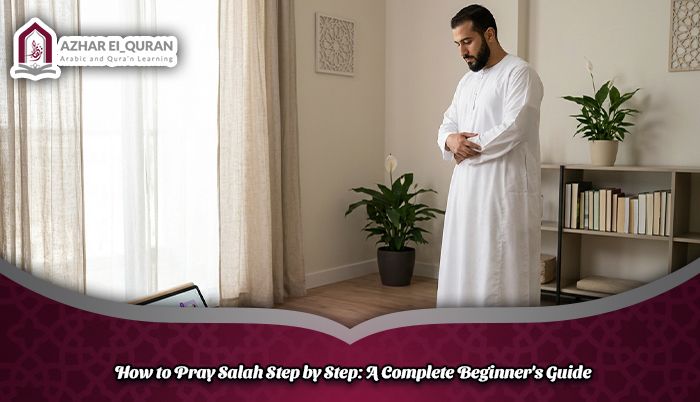
Learning how to pray Salah step by step can feel difficult when you are new to Islamic prayer. You may wonder which words to recite, how to perform each movement, or how to balance prayer practice with work, school, and family responsibilities.
The good news is that you do not need to learn everything in one day. With clear instructions, regular practice, and reliable guidance, you can gradually understand how to perform Salah correctly and develop confidence in your daily worship.
Salah is one of the most important acts of worship in Islam. It connects Muslims with Allah throughout the day and provides moments of reflection, gratitude, and spiritual discipline. Whether you are an adult learning to pray for the first time, a new Muslim, or a parent teaching your children, a simple prayer guide can make the process easier.
This complete beginner's guide explains how to pray Salah step by step, from performing Wudu and finding the Qibla to reciting the essential words and completing each prayer. You will also learn the number of Rak'ahs in the five daily prayers, common mistakes to avoid, and practical ways to improve your recitation.
For learners who prefer personal support, Azhar El-Quran Academy offers an option to explore structured online Quran and Islamic learning with qualified teachers. Learning with a suitable tutor can help you practise Arabic pronunciation, understand prayer movements, and ask questions as they arise.
The goal is not simply to memorise movements. It is to understand what you are doing and build a consistent, meaningful Salah practice at your own pace.
What Is Salah in Islam and Why Is It Important?
Salah is the formal Islamic prayer that Muslims perform at prescribed times each day. It is one of the Five Pillars of Islam and a central part of a Muslim's relationship with Allah. Muslims pray while standing, bowing, prostrating, and sitting, following an established order of actions and recitations.
For beginners, understanding the purpose of Salah makes learning its practical steps easier. Prayer is not only about memorising Arabic words. It is also an opportunity to remember Allah, express gratitude, seek forgiveness, and pause from everyday distractions.
The five daily prayers are:
- Fajr: The dawn prayer.
- Dhuhr: The midday prayer.
- Asr: The afternoon prayer.
- Maghrib: The prayer after sunset.
- Isha: The night prayer.
Each prayer has a prescribed time and a specific number of obligatory Rak'ahs. Muslims aim to perform these prayers regularly, with cleanliness, humility, and attention to what they recite.
When learning how to pray Salah step by step, remember that beginners may need time to become familiar with the movements and Arabic pronunciation. Children, adult learners, and new Muslims can all benefit from breaking the process into smaller lessons.
It is also helpful to learn the difference between Fard and Sunnah prayers. Fard prayers are obligatory, while Sunnah prayers are additional prayers associated with the practice of Prophet Muhammad (peace and blessings be upon him). Understanding this distinction helps beginners focus on the obligatory prayer before adding optional acts to their routine.
Salah becomes easier with consistent practice. Start by learning the basic movements and essential recitations, then work towards greater fluency and concentration.
What Do You Need Before Praying Salah?
Before beginning Salah, prepare yourself physically and mentally. Islamic prayer has requirements related to cleanliness, prayer time, covering the body, and facing the correct direction. Learning these foundations will help you understand how to perform Salah with confidence.
1. Perform Wudu (ablution)
Wudu is the ritual purification performed before prayer when required. It generally includes washing the hands, rinsing the mouth and nose, washing the face and arms, wiping the head, and washing the feet in the prescribed manner.
If you are not in a state of purification, learn how to perform Wudu according to reliable Islamic guidance. A person who needs a full ritual bath must complete that purification before praying. If water cannot be used under the conditions recognised in Islamic law, Tayammum may apply.
2. Wear clean clothing and choose a clean place
Your body, clothing, and prayer area must meet the relevant Islamic purity requirements. A prayer mat can provide a clean surface, but a mat is not compulsory if the place where you pray is clean.
3. Find the Qibla
The Qibla is the direction of the Ka'bah in Makkah. You can use a trusted Qibla compass, a suitable mobile app, or guidance from a local mosque.
4. Check the prayer time
Each obligatory prayer has its own time window. A local mosque timetable or a reliable prayer-time app can help you know when to pray, particularly when daylight hours change in the US, UK, Canada, and Australia.
5. Make your Niyyah
Niyyah means intention. You should intend in your heart which prayer you are about to perform. You do not need to say the intention aloud as a universal requirement.
Before starting, remove distractions where possible and give yourself a moment to focus. These preparations establish the foundation for learning how to pray Salah step by step.
How to Pray Salah Step by Step
The easiest way to learn Salah is to follow the prayer in the correct order. The instructions below explain a common method of performing the obligatory prayer. Some details, such as hand placement and certain recitations, differ between recognised schools of Islamic jurisprudence.
Make the Intention and Begin with Takbir
Stand upright facing the Qibla. Make the intention in your heart to perform the particular prayer, such as Fajr or Dhuhr. You do not need to announce your Niyyah aloud.
Raise your hands in the manner you have learned and say:
Arabic: الله أكبر
Transliteration: Allahu Akbar.
Meaning: Allah is the Greatest.
This opening declaration is called Takbiratul Ihram. It marks the beginning of Salah. Once you have entered the prayer, avoid ordinary conversation and actions that invalidate it.
Stand and Recite Surah Al-Fatihah
This standing position is called Qiyam. Place your hands according to the method taught by your school of practice, and direct your attention towards Allah.
You may recite an opening supplication after the opening Takbir, according to the practice you follow. Then recite Surah Al-Fatihah. Begin with Bismillah, and learn the Arabic words with accurate pronunciation.
After Al-Fatihah, recite another short Surah or Quranic passage in the first two Rak'ahs of the obligatory prayer. Beginners often start with Surah Al-Ikhlas because it is short and easy to practise.
Perform Ruku
Say Allahu Akbar as you move into Ruku, the bowing position. Bow with your back reasonably level, place your hands on your knees, and remain composed.
Recite:
Arabic: سُبْحَانَ رَبِّيَ الْعَظِيمِ
Transliteration: Subhana Rabbiyal Adheem.
Meaning: Glory be to my Lord, the Most Great.
Learn the words slowly before increasing your speed. Avoid rushing through the bowing position.
Stand Upright After Ruku
Rise from Ruku and return to a standing position, known as Qawmah.
While rising, say:
Arabic: سَمِعَ اللَّهُ لِمَنْ حَمِدَهُ
Transliteration: Sami Allahu liman hamidah.
Meaning: Allah hears the one who praises Him.
Once upright, say:
Arabic: رَبَّنَا وَلَكَ الْحَمْدُ
Transliteration: Rabbana wa lakal hamd.
Meaning: Our Lord, and to You belongs all praise.
Remain standing briefly before moving into prostration.
Perform the Two Sujud Prostrations
Say Allahu Akbar and move into Sujud, also called Sujood. Place your forehead and nose, palms, knees, and toes on the ground in the prescribed manner.
Recite:
Arabic: سُبْحَانَ رَبِّيَ الْأَعْلَى
Transliteration: Subhana Rabbiyal A'la.
Meaning: Glory be to my Lord, the Most High.
Rise from the first prostration and sit briefly in Jalsah. Remain composed, then perform the second Sujud with the same essential recitation.
These two prostrations complete the main movements of one Rak'ah. Practise moving between the positions smoothly instead of treating Salah as a race.
Complete the Remaining Rak'ahs
After the second Sujud, stand for the next Rak'ah if the prayer requires one. Repeat the standing, recitation, bowing, and prostration in the correct order.
In the third and fourth Rak'ahs of the obligatory prayers, the usual practice is to recite Surah Al-Fatihah without adding another Surah. Details can vary according to the prayer and the school of jurisprudence you follow.
Recite Tashahhud and Finish with Tasleem
After the second Rak'ah, sit for the first Tashahhud when the prayer has additional Rak'ahs. In the final Rak'ah, sit for the final Tashahhud and recite the Salawat Ibrahimiyyah, which includes blessings upon Prophet Muhammad (peace and blessings be upon him) and Prophet Ibrahim (peace be upon him).
Finish the prayer with Tasleem by turning your head to the right and saying:
Arabic: السَّلَامُ عَلَيْكُمْ وَرَحْمَةُ اللَّهِ
Transliteration: Assalamu Alaikum wa Rahmatullah.
Meaning: Peace and the mercy of Allah be upon you.
The commonly taught method also includes saying the Tasleem to the left. With these steps, you have learned the basic sequence for praying Salah. For precise instruction, practise with a qualified teacher who can demonstrate the movements and explain differences between prayer traditions.
How Many Rak'ahs Are in Each Daily Prayer?
A Rak'ah is one complete unit of prayer. It includes standing and recitation, Ruku, and two Sujud prostrations, with the required transitions between them.
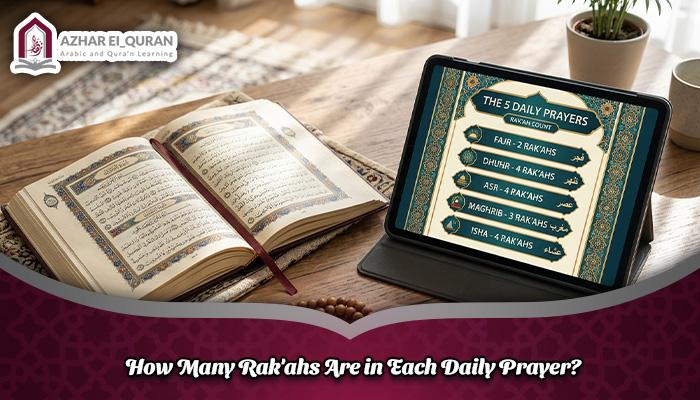
The five daily obligatory prayers contain the following numbers of Rak'ahs:
|
Daily prayer |
Obligatory Rak'ahs |
General time |
|---|---|---|
|
Fajr |
2 |
Dawn |
|
Dhuhr |
4 |
After midday |
|
Asr |
4 |
Afternoon |
|
Maghrib |
3 |
After sunset |
|
Isha |
4 |
Night |
These are the obligatory Rak'ahs, also called Fard. Sunnah prayers may be performed before or after certain obligatory prayers, depending on the prayer and the practice you follow. Witr is also an important prayer associated with the night, with details varying across schools.
For beginners, focus first on learning the obligatory prayers and their correct sequence. You can add the associated Sunnah prayers as your understanding grows.
It may help to practise one prayer at a time. Start with Fajr because it contains two obligatory Rak'ahs. Once you understand its movements and recitations, learn the longer prayers.
If you are teaching children, use a simple timetable with the prayer names and Rak'ah counts. Adults can also use a checklist while studying outside prayer time. These tools support learning, but a checklist should not replace the prayer itself.
When learning how to pray Salah step by step, remember that the number of obligatory Rak'ahs is different from the total number of prayers a Muslim may perform throughout the day. Understanding this distinction prevents confusion as you progress.
What Should You Say During Salah?
Learning the essential recitations is a major part of becoming comfortable with Salah. Beginners often find Arabic pronunciation challenging, particularly if they have never studied the Arabic alphabet. Start with a few phrases, practise their sounds, and gradually learn their meanings.
The following recitations are useful starting points.
1. Opening Takbir
Arabic: اللَّهُ أَكْبَرُ
Transliteration: Allahu Akbar.
Meaning: Allah is the Greatest.
2. Surah Al-Fatihah
Arabic: بِسْمِ اللَّهِ الرَّحْمَٰنِ الرَّحِيمِ
Transliteration: Bismillahir-Rahmanir-Raheem.
Meaning: In the name of Allah, the Most Compassionate, the Most Merciful.
This is the opening verse in the commonly used numbering of Surah Al-Fatihah. Learn the complete Surah rather than relying on this opening alone.
3. Words of praise in Ruku
Arabic: سُبْحَانَ رَبِّيَ الْعَظِيمِ
Transliteration: Subhana Rabbiyal Adheem.
Meaning: Glory be to my Lord, the Most Great.
4. Words of praise in Sujud
Arabic: سُبْحَانَ رَبِّيَ الْأَعْلَى
Transliteration: Subhana Rabbiyal A'la.
Meaning: Glory be to my Lord, the Most High.
5. Tasleem
Arabic: السَّلَامُ عَلَيْكُمْ وَرَحْمَةُ اللَّهِ
Transliteration: Assalamu Alaikum wa Rahmatullah.
Meaning: Peace and the mercy of Allah be upon you.
You should also learn the complete Tashahhud, beginning with At-Tahiyyatu, and the Salawat Ibrahimiyyah. These are longer recitations, so learn them with a reliable teacher or a trusted prayer resource.
Transliteration helps you begin, but it cannot fully represent every Arabic sound. Listen to a qualified reciter and practise gradually. When following a Salah tutorial or prayer demonstration, choose a resource that explains both the movements and the words instead of relying only on a video.
Common Salah Mistakes Beginners Should Avoid
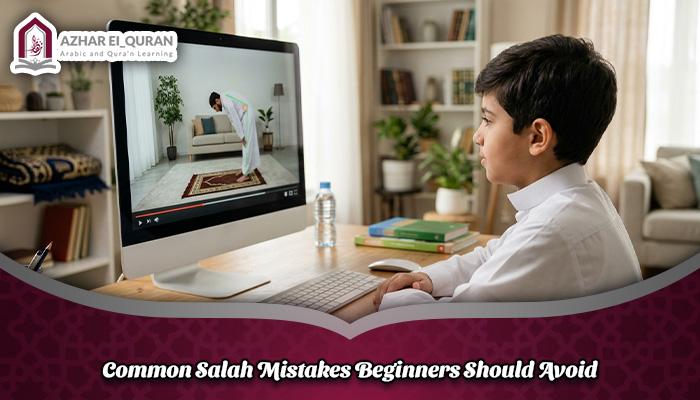
When learning how to pray Salah step by step, mistakes are a normal part of the learning process. The important thing is to identify areas that need improvement and seek reliable guidance rather than becoming discouraged.
Rushing through the movements. Salah includes moments of standing, bowing, prostrating, and sitting. Each position should be performed with composure. Avoid moving so quickly that you cannot settle into the required posture.
Confusing the order of the prayer. The movements and recitations follow a defined sequence. Practise the full order outside prayer time with a teacher, then gradually build confidence performing it independently.
Struggling with Arabic pronunciation. Words such as Subhana Rabbiyal Adheem may seem difficult at first. Break each phrase into smaller parts, listen carefully, and repeat it aloud during practice sessions outside Salah.
Forgetting the number of Rak'ahs. Beginners may lose track, particularly during longer prayers. Learning the structure of each prayer and practising with guidance can help. If you are uncertain during an actual prayer, follow the relevant rulings taught by your school rather than guessing at a general online instruction.
Overlooking preparation. Check the prayer time, purification, clothing, and Qibla before starting. A short preparation routine can reduce distractions.
Focusing only on memorisation. Understanding the English meaning of the recitations can help you develop greater concentration. Take time to learn what the words mean and reflect on their significance.
Relying on unverified online instructions. Not every online demonstration explains the differences between Islamic schools or distinguishes obligatory acts from recommended practices. Use trustworthy sources and ask a qualified teacher when something is unclear.
Remember that learning how to perform Islamic prayer correctly takes practice. If you discover that you have made a mistake, ask a knowledgeable teacher how it should be addressed. Not every mistake has the same ruling, and some situations require specific guidance.
How to Learn Salah More Easily
A simple routine can make learning Salah more manageable for children, adults, and new Muslims. Rather than trying to memorise everything at once, divide the learning process into small goals.
Begin with one skill at a time. Spend a few days learning the prayer movements and their names. Then focus on the opening Takbir, Surah Al-Fatihah, and the short recitations used in Ruku and Sujud.
Listen and repeat. Choose a reliable recording of the Arabic recitations. Listen to one phrase, pause, and repeat it. Pay attention to the sounds instead of memorising the transliteration alone.
Practise regularly. Set aside 10–15 minutes outside prayer time for focused learning. Review the words you already know before introducing new ones.
Watch a clear demonstration. A good Salah video should show the movements in the correct order and explain the recitations. Use it as a learning aid, not as a substitute for personalised instruction when you need correction.
Learn with a qualified teacher. A teacher can help you correct pronunciation, understand the requirements of prayer, and resolve questions about the method you follow.
For families in the US, UK, Canada, and Australia, online lessons can offer a practical way to learn around school, work, and family commitments. One-to-one classes may be particularly helpful for beginners who feel shy about asking questions in a group.
Azhar El-Quran Academy can be explored as an option for learning Quran and Islamic studies. Before enrolling, ask about teacher qualifications, lesson formats, available schedules, and whether the programme includes practical Salah instruction alongside Quran recitation.
A free trial lesson, if available, can help you assess whether the teaching approach suits your needs. The right support should make you feel comfortable asking questions and practising at your own pace.
Most importantly, stay consistent. Learning how to pray Salah step by step is a process, and small improvements over time can build lasting confidence.
Frequently Asked Questions About Salah
How do beginners pray Salah for the first time?
Begin by learning Wudu, checking the prayer time, facing the Qibla, and making your intention. Then learn the prayer movements and essential recitations in order, seeking qualified guidance when needed.
Can I learn Salah in English?
You can use English explanations and translations to understand the meanings of Salah. The prescribed Quranic recitations and essential Arabic formulas should be learned in Arabic, with a teacher helping you develop accurate pronunciation.
How long does it take to learn how to pray Salah?
The time varies depending on your previous knowledge, practice routine, and access to instruction. Regular short practice sessions can help you learn the basic sequence and essential recitations gradually.
Can I learn how to pray Salah online?
Yes, online lessons, reliable prayer demonstrations, and guided recitation exercises can help beginners learn from home. A qualified teacher can provide personalised feedback and explain questions that videos alone may not address.
Conclusion: Start Learning Salah with Confidence
Learning how to pray Salah step by step is an important part of developing your daily Islamic practice. Start with the foundations, learn the movements in order, and practise the essential recitations until they become more familiar.
You do not need to master every detail immediately. Consistent effort, reliable resources, and appropriate guidance can help you develop confidence while deepening your understanding of Salah.
Ready to improve your prayer with expert guidance? Explore Azhar El-Quran Academy's online learning options and ask about a free trial lesson with a qualified Quran teacher. Take your first step towards more confident recitation and a better understanding of Islamic prayer today.