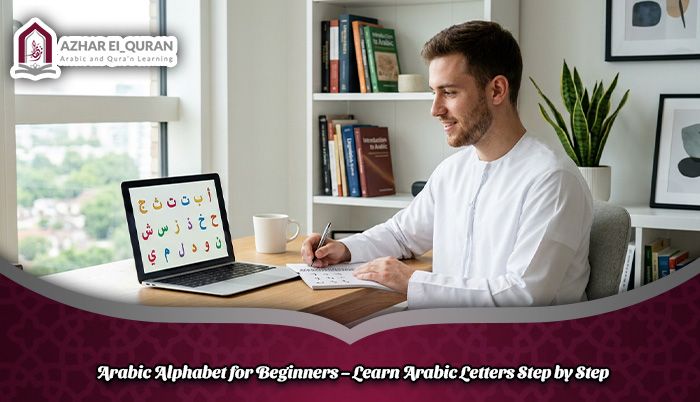
The Arabic alphabet has 28 fundamental letters, each with unique isolated, initial, medial, and final forms. Mastering these variations is crucial to reading and writing fluently. Beginners should also familiarize themselves with vowel markings (fathah, kasrah, dammah) and the hamza to ensure precise pronunciation. Engaging with audio resources aids in developing native-like articulation.
Learning a new writing system can feel confusing at first. Many beginners struggle to find qualified teachers, understand unfamiliar sounds, or know where to start with the Arabic alphabet. For Muslim families in the West, there can also be the challenge of balancing school, work, and Islamic education.
The good news is that learning the Arabic alphabet does not have to feel difficult. With a clear method, regular practice, and guidance from a qualified native Arabic teacher, beginners can learn Arabic letters one step at a time. Children, adults, new Muslims, and complete beginners can all build a strong foundation from home.
The Arabic alphabet is especially important for Muslims who want to read the Quran, understand basic Arabic words, or begin studying Quranic Arabic. Before moving into Tajweed, Quran reading, vocabulary, or Arabic grammar, learners need to recognise letters, understand their sounds, and learn how they work inside words.
At Azhar El-Quran Academy, students can learn the Arabic alphabet through structured online lessons with experienced native Arabic tutors. Arabic lessons can be adapted to the learner's age and level, making Arabic learning easier for both children and adults.
Whether you are teaching a child, starting as an adult, or helping your family build a stronger connection with the Quran, this step-by-step guide explains the essentials of the Arabic alphabet and shows you how to start learning with confidence.
What Is the Arabic Alphabet?
The Arabic alphabet is the writing system used to write Arabic. It is also the script of the Quran, which makes learning Arabic letters an important first step for Muslims who want to improve their Quran reading.
Unlike English, the Arabic alphabet is written from right to left. This may seem unusual at first, especially for learners who are used to reading English. However, children and adults usually become comfortable with the direction after regular practice.
The letters also have their own sounds. Some Arabic sounds are similar to English sounds, while others are produced in different parts of the mouth or throat. This is why listening to a qualified teacher is often more effective than relying only on written transliteration.
The Arabic alphabet gives learners the foundation for several important skills:
- Reading Arabic words
- Writing Arabic letters
- Improving pronunciation
- Learning Quranic Arabic
- Preparing to read the Quran
- Beginning Arabic vocabulary and grammar
For Muslim beginners, learning the Arabic alphabet can be the first stage of a wider Islamic education. A child may begin by recognising letters and later progress to Noorani Qaida, Quran reading, Tajweed, and memorisation.
Adults can follow the same basic process. It is never too late to learn the Arabic alphabet, even if you have never studied Arabic before.
A good teacher breaks the process into small, manageable lessons. Instead of trying to memorise everything at once, students learn a few letters, practise their sounds, review them, and then move forward.
This gradual approach makes the Arabic alphabet much less intimidating and gives learners time to build confidence.
How Many Letters Are in the Arabic Alphabet?
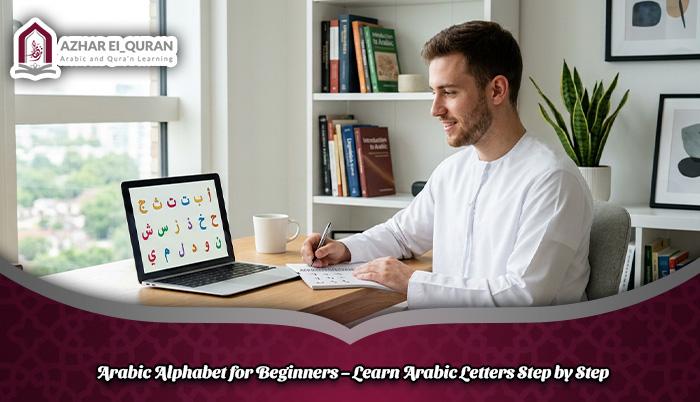
The standard Arabic alphabet contains 28 basic letters. Each letter has its own name and sound, although some sounds may be unfamiliar to English speakers.
Learning all 28 letters may sound like a large task, but beginners do not need to master them in one lesson. A structured programme introduces the letters gradually and gives students time to recognise, pronounce, write, and review them.
The 28 letters of the Arabic alphabet are:
ا ب ت ث ج ح خ د ذ ر ز س ش ص ض ط ظ ع غ ف ق ك ل م ن ه و ي
At first, some letters may appear similar. For example, ب, ت, and ث have related shapes but use different dots. This is one reason why visual practice is important.
Beginners should learn to notice:
- The basic shape of each letter
- The number and position of dots
- The name of the letter
- Its correct sound
- How the letter changes in a word
Children often respond well to colourful worksheets, games, tracing activities, and an Arabic alphabet song. A simple alphabet song can make letter recognition more fun and memorable, especially for kindergarten children and toddlers.
Adults may prefer flashcards, writing exercises, listening practice, and live lessons with a tutor. The learning method can change, but the goal remains the same: recognise every letter and pronounce it correctly.
A professional teacher can also help learners avoid confusing similar letters. Early correction is valuable because pronunciation habits can become harder to change later.
By learning the Arabic alphabet step by step, students can focus on understanding rather than rushing. Once the letters become familiar, reading simple Arabic combinations becomes much easier.
Learn the Arabic Letters and Their Sounds
Recognising the shape of an Arabic letter is only part of the process. Students also need to learn how each letter sounds.
The Arabic alphabet includes familiar sounds such as ب (baa), م (meem), and ن (noon). It also includes sounds that do not have an exact equivalent in English, such as ع, ح, خ, and ق.
These unfamiliar sounds can feel challenging at first. The best approach is to listen carefully, repeat the sound, and receive correction from a qualified teacher.
When you learn the Arabic alphabet, focus on listening before trying to perfect every sound. Accuracy develops through repetition.
A useful lesson may follow this pattern:
- The teacher introduces the letter.
- The student sees its shape.
- The teacher demonstrates the sound.
- The student repeats it.
- The student practises identifying the letter.
- The teacher corrects.
- The student reviews the letter in the next lesson.
This process is simple, but it works well for beginners.
Children can benefit from animated educational videos, colourful cards, letter games, and songs. Associating letters with familiar images or animals can make learning more engaging and fun.
However, games should support proper learning rather than replace it. An entertaining Arabic alphabet song can help children remember letter order, but students still need individual practice to master each sound.
For Quran learners, pronunciation is particularly important. Arabic letters can have similar sounds, but a small difference in pronunciation may change the way a word is read.
This is why live instruction can be valuable. At Azhar El-Quran Academy, learners can practise the Arabic alphabet with a tutor who listens to their pronunciation and provides direct guidance.
Arabic Alphabet Pronunciation for Beginners
Correct pronunciation is one of the most important parts of learning the Arabic alphabet. Beginners often make the mistake of reading Arabic letters according to English pronunciation habits.
Arabic has its own sound system. Some letters are pronounced using the lips, tongue, teeth, throat, or other points of articulation.
For example, learners may need extra practice with letters such as:
- ح
- خ
- ع
- غ
- ق
- ص
- ض
- ط
- ظ
These letters should not be replaced with the closest English sound. Doing so may make learning easier for a moment, but it can create pronunciation problems later.
A native Arabic teacher can demonstrate how sounds are produced and help students adjust their pronunciation. This is especially useful for learners preparing to read the Quran, where correct letter articulation supports proper Tilawah and later Tajweed study.
Beginners do not need to worry about becoming perfect immediately. The goal is steady improvement.
Regular listening and repetition can make a major difference. Even ten or fifteen minutes of focused practice can help students remember difficult sounds.
Children may enjoy repeating letters through songs, games, or animated educational activities. Adults may prefer one-to-one correction and slower practice.
A good Arabic lesson gives students time to speak. Simply watching a video is useful, but interactive learning allows the teacher to hear mistakes and provide immediate feedback.
As learners become comfortable with the sounds, the Arabic alphabet starts to feel more familiar. This confidence prepares them for writing, connecting letters, and eventually reading complete Arabic words.
How to Write the Arabic Alphabet Step by Step
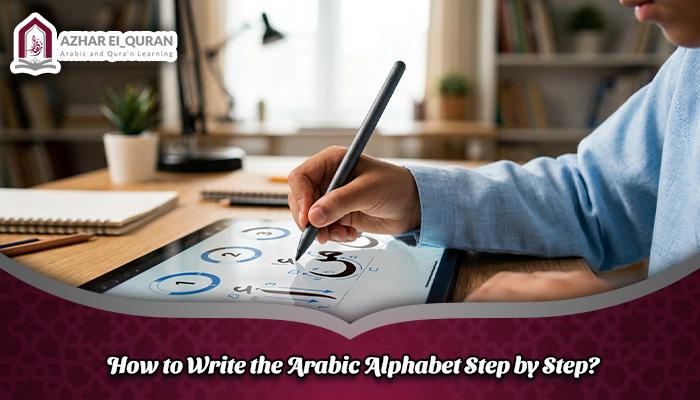
Learning to write the Arabic alphabet helps students recognise letters more quickly and understand how their shapes are formed.
Arabic is written from right to left. Beginners should take time to become comfortable with this direction rather than trying to write quickly.
Start with one letter at a time. Look carefully at its shape and practise writing it repeatedly. Tracing activities can be particularly useful for children, kindergarten learners, and complete beginners.
Printable worksheets can also support independent practice at home.
A simple writing routine may include:
- Looking at the letter
- Tracing the letter
- Copying the letter
- Writing it without help
- Saying the letter's sound while writing
- Reviewing it later
This combination of visual, physical, and listening practice can strengthen memory.
Children often enjoy colourful worksheets and letter tracing activities. Parents can turn practice into a fun learning game by setting small goals or asking children to identify a letter before writing it.
For adults, neat handwriting should not become a source of stress. The main purpose is to understand the structure of the Arabic alphabet and become familiar with each letter.
It is also important to learn the difference between printed Arabic fonts and handwritten Arabic. A letter may look slightly different depending on the style, but its basic identity remains the same.
A qualified tutor can demonstrate the correct writing process and explain how letters are formed. This is especially helpful when learners move from individual letters to connected writing.
Writing practice also supports Quran reading. When learners understand how Arabic letters are shaped, they often find it easier to recognise them in Quranic words.
With consistent practice, writing the Arabic alphabet becomes more natural and less dependent on worksheets or guides.
Learn How Arabic Letters Change Their Shape
One feature that makes the Arabic alphabet different from English is that many letters change their shape depending on where they appear in a word.
A letter can have different forms when it appears:
- At the beginning of a word
- In the middle of a word
- At the end of a word
- By itself
This may seem complicated, but there is a clear pattern behind it.
For example, a letter keeps its identity even when its shape changes. The basic features, including dots and overall structure, help learners recognise it.
Not every letter connects to the letter that follows it. Several letters only connect from one side. These include:
ا د ذ ر ز و
Learning this rule is an important part of understanding how the Arabic alphabet works.
Students should not try to memorise every possible word form immediately. Begin with individual letters, then compare the isolated form with the initial, middle, and final forms.
Visual charts can be useful at this stage. A teacher can also show examples and ask students to identify the same letter in different positions.
For children, matching games can make this lesson more engaging. One card can show the isolated letter, while another shows the letter inside a word.
For adults, repeated reading and writing exercises are often effective.
This is where structured lessons can save time. Instead of trying to work out the patterns alone, students receive a clear explanation and guided practice.
As learners understand changing letter shapes, Arabic writing becomes less mysterious. They begin to see that connected Arabic words are made from familiar letters following predictable rules.
How to Connect Arabic Letters to Form Words
After learning individual letters and their changing forms, the next step is to connect them.
Arabic letters join together to create words, although not every letter connects in the same way. Understanding this system helps learners move from recognising the Arabic alphabet to actually reading Arabic.
The process should begin with short combinations.
A teacher may introduce two connected letters first. Once the learner recognises them comfortably, three-letter combinations can follow.
For example, students gradually learn to:
- Identify each letter
- Recognise where one letter ends
- Notice how the next letter begins
- Understand when letters connect
- Read the sounds in order
At this stage, slow practice is more valuable than speed.
Children can use cards or simple games to build words. Adults can benefit from reading exercises that focus on common letter combinations.
The goal is not to memorise hundreds of words immediately. The goal is to understand how the Arabic alphabet works when letters appear together.
Students may initially find connected writing difficult because the individual shapes are less obvious. This is normal.
With practice, the eye begins to recognise common patterns. A learner who once saw a complicated Arabic word will gradually begin to identify the individual letters inside it.
This stage is particularly important for learners preparing to study Noorani Qaida or read the Quran. It creates a bridge between basic letter recognition and actual reading.
At Azhar El-Quran Academy, one-to-one lessons can help students move through this stage at their own pace. Beginners can spend more time on difficult combinations instead of feeling pressured to keep up with a group.
Arabic Vowels and Harakat for Beginners
Learning the letters alone is not enough to begin reading Arabic. Beginners also need to understand basic vowel marks, known as Harakat.
These marks help indicate how a letter should be pronounced.
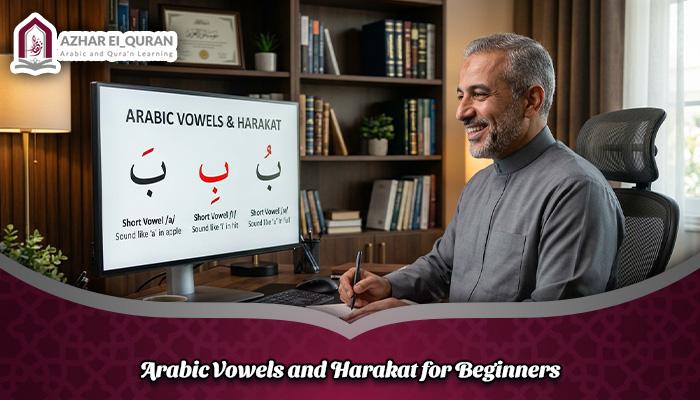
The three basic short vowels are:
- Fathah (ـَ) – produces a short “a” sound
- Kasrah (ـِ) – produces a short “i” sound
- Dammah (ـُ) – produces a short “u” sound
When students combine the Arabic alphabet with Harakat, they can begin producing simple syllables and sounds.
For example, the same letter can sound different depending on the vowel mark placed with it.
This is an exciting stage because learners start moving beyond letter names. They begin reading actual sounds.
Students may later learn other important marks, including:
- Sukoon (ـْ)
- Shaddah (ـّ)
- Tanween
- Long vowel sounds
For Quran learners, understanding these marks is essential. Quranic Arabic uses vowel markings to guide correct Quran recitation, especially in learning materials designed for beginners.
A qualified teacher can explain Harakat gradually and ensure that students do not confuse the different sounds.
Children may learn through colourful charts and worksheets. Adults may prefer practical reading exercises.
The key is regular practice. A learner should read short combinations repeatedly until the connection between the letter and its vowel becomes natural.
Once students understand the Arabic alphabet and basic Harakat, they are ready to progress towards reading Arabic words with greater confidence.
How to Learn the Arabic Alphabet Easily
The easiest way to learn the Arabic alphabet is to follow a clear plan and practise consistently. Trying to memorise all the letters, sounds, shapes, and writing rules at once can feel overwhelming.
Instead, divide learning into small steps.
A simple plan could look like this:
Step 1: Learn a few letters at a time.
Focus on recognising the shape, name, and sound.
Step 2: Practise every day.
Short, regular lessons are usually more effective than occasional long sessions.
Step 3: Listen and repeat.
Hearing correct pronunciation helps learners develop better habits.
Step 4: Use writing and tracing practice.
Writing strengthens letter recognition.
Step 5: Review regularly.
Do not move forward too quickly. Review older letters alongside new ones.
Step 6: Learn through enjoyable activities.
Children can use games, songs, animated educational videos, printable worksheets, and an alphabet song to make learning more exciting.
Step 7: Learn with a qualified teacher.
A teacher can identify mistakes that may be difficult to notice when studying alone.
A combination of independent practice and live instruction often works very well. Videos and songs can introduce the material, while a teacher provides correction and structure.
Parents can also support children by keeping lessons short and positive. A child does not need to study for hours. A consistent routine can be more effective and more enjoyable.
For adults, one-to-one online lessons offer flexibility. Students can learn from home and schedule classes around work, family, or other commitments.
At Azhar El-Quran Academy, beginners can learn the Arabic alphabet with experienced native Arabic teachers through structured online lessons. Students can receive personalised guidance, practise pronunciation, and progress step by step.
The right method makes Arabic learning feel achievable. You do not need to know Arabic before you begin. You simply need a clear starting point and consistent practice.
Frequently Asked Questions About the Arabic Alphabet
How many letters are in the Arabic alphabet?
The Arabic alphabet has 28 basic letters. Many letters change their shape depending on whether they appear at the beginning, middle, or end of a word.
Is the Arabic alphabet difficult to learn?
The Arabic alphabet can feel unfamiliar at first because Arabic is written from right to left and includes sounds that do not exist in English. With regular practice and guidance from a qualified teacher, most beginners can learn the basics step by step.
How long does it take to learn the Arabic alphabet?
The time varies depending on the learner's age, study schedule, and practice. With consistent lessons and daily review, beginners can usually make steady progress within a relatively short period.
Can children learn the Arabic alphabet online?
Yes. Children can learn through live lessons, interactive games, songs, tracing, colourful worksheets, and age-appropriate activities. A qualified teacher can adapt the lessons to the child's level and keep the learning process engaging.
Start Learning Arabic Letters with Confidence
Learning the Arabic alphabet is the first step towards reading Arabic, understanding Quranic words, and building a stronger connection with the language of the Quran. You do not need to learn everything in one day. Start with the letters, practise their sounds, understand how they connect, and build your skills gradually.
With structured guidance, regular practice, and the support of a qualified teacher, beginners of all ages can make real progress.
Ready to learn the Arabic alphabet step by step? Book a free trial lesson with a native Arabic teacher at Azhar El-Quran Academy and start building a strong foundation in Arabic from the comfort of your home.