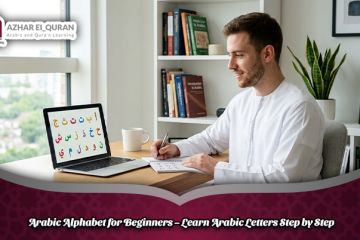
Quran Arabic lessons focus on mastering classical Arabic used in the Quran, enabling learners to read, understand, and recite it accurately. Platforms like Azhar El-Quran Academy offer structured, free, and comprehensive courses that emphasize pronunciation, grammar, and meaning. These lessons help bridge the gap between translation and direct engagement with the original text, deepening spiritual and linguistic understanding.
Online Islamic education makes it easier for new Muslims, beginners, kids, and adults to study Arabic with qualified teachers. Well-designed Quranic Arabic lessons introduce the Arabic alphabet, vocabulary, grammar, word structures, and common Quranic expressions step by step. They can also help students connect Arabic words with their meanings instead of depending entirely on translation.
For beginners, the most important thing is to start with a clear learning plan. You do not need to master everything at once. A good course takes you from the alphabet and basic words to grammar and Quranic sentence structures gradually. With regular practice, even a complete beginner can make steady progress.
This guide explains how Quranic Arabic lessons work, what you can learn, and how to choose the right online Quranic Arabic course. It also explains why Azhar El-Quran Academy can be a valuable choice for students who want structured and accessible Quranic Arabic education from home.
What Are Easy Quran Arabic Lessons?
Easy Quranic Arabic lessons are structured lessons designed to help students understand the Arabic used in the Quran. Instead of teaching every area of modern Arabic, these lessons focus on the vocabulary, grammar, expressions, and structures that frequently appear in the Quran. This focused approach can make learning Quranic Arabic easier for beginners.
A good course usually begins with the Arabic alphabet and basic script recognition. Students learn how letters look, how they connect, and how their sounds change depending on their position in a word. This foundation is especially useful for students who are still developing their Quran reading skills.
After the alphabet, Quranic Arabic lessons can introduce common vocabulary and simple words. Students may study frequently repeated Quranic words and learn their meanings through examples. Gradually, they can move toward grammar, sentence structures, and basic nahw, which is an important part of understanding Arabic grammar.
The aim is not simply to memorize hundreds of words. The goal is to recognize patterns and understand how words work together. A well-organized program gives students repeated opportunities to practice these skills.
For someone who wants to learn Quranic Arabic online, simple lessons can provide a practical starting point. Students can study from home, review previous material, and move forward one step at a time without feeling overwhelmed.

Benefits of Learning Quranic Arabic Online
Online Quranic Arabic lessons provide flexibility that traditional classes may not always offer. Students can study from home and choose lesson times that fit their daily responsibilities. This can be particularly helpful for adults with work commitments, parents, university students, and families with busy schedules.
One major benefit is access to qualified teachers. Instead of limiting your choices to instructors in your local area, online Quranic Arabic programs can connect you with teachers who have experience teaching Arabic and Quranic studies. A teacher can explain difficult concepts, correct mistakes, and adjust lessons according to your level.
Another advantage is personalized learning. Some students learn vocabulary quickly but need more time with grammar. Others may understand grammar but struggle with reading the Arabic script. Effective Quranic Arabic lessons can address these differences instead of forcing every learner through the same pace.
Online study can also make revision easier. Students may use digital materials, notes, recorded resources, or approved educational apps to review vocabulary between lessons. However, technology should support learning rather than replace a qualified teacher.
The biggest benefit is practical understanding. As your vocabulary and grammar improve, you may begin recognizing familiar words when reading the Quran. This can make Quran reading more meaningful and encourage you to continue learning.
With consistent Quranic Arabic lessons, students can gradually build confidence while developing a stronger connection with the language of the Quran.
Quran Arabic Lessons To Understand the Quran
The main purpose of many Quranic Arabic lessons is to help students understand the Quran more directly. Translation is extremely useful, but Arabic knowledge allows learners to notice words, expressions, and grammatical relationships that may not always be obvious in another language.
Vocabulary is an important starting point. The Quran contains many words and roots that appear repeatedly. Learning commonly used vocabulary can therefore give beginners useful progress early in their studies. Instead of trying to memorize random words, students can focus on words that frequently occur in Quranic passages.
Grammar is another key area. Basic Arabic grammar helps students understand how words relate to one another. Lessons may introduce subjects, verbs, objects, pronouns, adjectives, and other structures. Later, students can explore more advanced areas of nahw and related grammatical concepts.
The learning process should always connect theory with the Quran. For example, a teacher can introduce a grammatical structure and then show how that structure appears in a familiar verse. This makes the lesson practical and gives students a reason to remember what they have learned.
Effective Quranic Arabic lessons also teach students how to look at a word in context. A single Arabic word can have different meanings depending on how it is used. Context therefore matters when developing Quranic understanding.
If your goal is to learn Quranic Arabic so that you can better understand quran verses, choose lessons that combine vocabulary, grammar, reading, and practical Quran examples. This approach creates stronger understanding than memorizing isolated translations.
Learn Quranic Arabic Online with Expert Teachers
Choosing the right teacher can make a major difference when you learn Quranic Arabic online. Arabic can seem difficult at first, especially when students encounter unfamiliar letters, grammatical terms, or new word patterns. A supportive teacher can make these challenges much easier to manage.
Experienced teachers know how to explain difficult ideas in simple language. Instead of giving beginners complicated grammar rules immediately, they can introduce one concept at a time. They can also use Quranic examples to show how each rule works in practice.
At Azhar El-Quran Academy, students can explore structured online Quran and Arabic learning with teachers who guide them through the learning process. The academy can be a useful option for families and individuals seeking organized Quranic Arabic lessons from home.
Teacher feedback is particularly important for beginners. When a student reads Arabic incorrectly, misunderstands a word, or applies a grammar rule incorrectly, immediate correction can prevent the mistake from becoming a habit. Personal guidance also helps students remain motivated.
Good teachers understand that every learner is different. A child may need visual activities and repetition, while an adult beginner may prefer detailed explanations. A new Muslim may also need additional context when encountering Islamic vocabulary for the first time.
The best Quranic Arabic lessons therefore combine teacher expertise with patience and communication. The goal is to make students feel comfortable asking questions and practicing without fear of making mistakes.
With consistent instruction and regular practice, learners can gradually master Arabic skills that support deeper Quran study.

Quran in Arabic Lessons for Beginners
Beginners often wonder where they should start. The answer is to build a strong foundation rather than rushing into advanced grammar. Well-planned Quranic Arabic lessons should take learners through a logical sequence.
The first stage may involve the Arabic alphabet, pronunciation, and script. Students learn to identify letters and recognize how they appear in different positions. This stage is important because reading Arabic confidently makes later vocabulary and grammar study much easier.
The next stage focuses on basic vocabulary. Students can learn common Quranic words and understand their meanings through simple examples. Repetition is essential because vocabulary becomes easier to remember when learners encounter the same word several times.
After vocabulary, students can begin learning simple grammar and word structures. They may study nouns, verbs, pronouns, singular and plural forms, and common sentence patterns. These concepts help learners see how individual words form meaningful expressions.
Beginners should not expect instant fluency. Learning Quranic Arabic is a gradual process. Some concepts will feel easy, while others may require several lessons and repeated practice. This is completely normal.
The advantage of online study is that students can progress at a manageable pace. They can review previous lessons before moving forward and ask their teacher to explain anything they do not understand.
For beginners, effective Quranic Arabic lessons should feel achievable. Each lesson should provide one clear learning goal and enough practice to build confidence. Small improvements made consistently can eventually lead to significant progress.
Quran Arabic Lessons for Kids and Adults
Children and adults can both benefit from Quranic Arabic lessons, but their learning needs are different. A successful online program should recognize these differences and adapt the teaching approach accordingly.
Children often learn best through repetition, interaction, stories, visual examples, and short activities. They may need help staying focused during a lesson. When Arabic is presented in an age-appropriate way, children can gradually become familiar with the alphabet, vocabulary, and Quranic words without feeling pressured.
Adults may prefer a more structured explanation. They often want to know why a grammatical rule works and how it applies to the Quran. Adult learners may also have specific goals, such as understanding prayer, improving Quran reading, or studying Quranic vocabulary.
New Muslims can particularly benefit from beginner-friendly Quranic Arabic lessons. Learning the language alongside basic Islamic knowledge can help them recognize important Arabic terms used in the Quran and daily worship.
Families may also choose online learning because parents and children can study from the same home environment. Parents can encourage regular practice while teachers provide professional guidance.
Regardless of age, repetition remains essential. Learners should regularly review vocabulary, practice reading the Arabic script, and revisit grammar concepts. A few minutes of daily revision can often be more effective than studying for several hours only once a week.
The right Quranic Arabic lessons should therefore be flexible enough to support different ages and learning levels. Whether you are a child taking your first Arabic lesson or an adult returning to Arabic after many years, the learning experience should be supportive and practical.
Flexible Quranic Arabic Classes for Busy Learners
One of the strongest reasons to choose online Quranic Arabic classes is flexibility. Many learners genuinely want to study but struggle to fit classes into a busy routine. Work, school, family responsibilities, and daily commitments can make fixed classroom schedules difficult.
Online learning offers a more convenient alternative. Students can often choose lesson times that fit their availability. This is especially helpful for families with multiple children or adults whose schedules change during the week.
Flexibility also applies to learning speed. Some students may need extra time to understand grammar, while others may progress quickly through basic vocabulary. A personalized approach allows learners to focus on areas where they need additional practice.
However, flexibility should not mean inconsistency. Students should create a realistic routine and follow it. Even two or three regular sessions each week can provide meaningful progress when combined with short periods of independent revision.
Between classes, learners can review vocabulary, read short Quranic passages, practice the alphabet, and revisit previous grammar concepts. Simple apps and online resources can support this process, but students should make sure their materials are accurate and suitable for Quranic Arabic study.
Well-structured Quranic Arabic lessons can fit into different lifestyles without sacrificing educational quality. This makes online learning especially attractive to adults, parents, students, and new Muslims.
The key is consistency. A flexible schedule becomes effective when learners make learning Quranic Arabic part of their routine rather than treating it as an occasional activity.
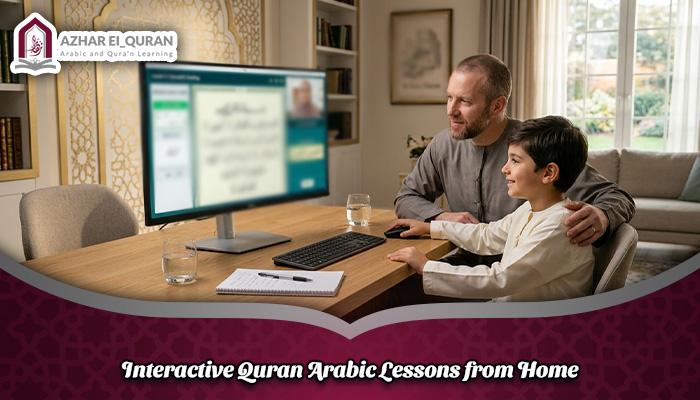
Interactive Quran Arabic Lessons from Home
Interactive Quranic Arabic lessons can make online learning more engaging and effective. Instead of simply listening to a teacher, students should have opportunities to read, answer questions, identify vocabulary, practice grammar, and apply new concepts.
Reading practice is particularly valuable. A teacher can display a Quranic word or short passage and ask the student to identify familiar words. This activity encourages active learning and helps students develop recognition skills.
Vocabulary exercises can also make lessons more memorable. Students may learn a new word and then use it in several Quranic examples. Repeated exposure helps move vocabulary from short-term memory into long-term understanding.
Grammar should also be interactive. Rather than memorizing a rule without context, learners can examine a Quranic sentence and identify the role of each word. This helps students understand how Arabic structures work.
Online learning from home can also create a comfortable environment. Students can ask questions freely and revisit concepts that seem difficult. Parents can support children by encouraging them to review their lessons after class.
Interactive Quranic Arabic lessons should also be purposeful. Games and activities can be useful, particularly for children, but they should always support a clear learning objective.
The ultimate aim is to help learners become active readers rather than passive recipients. As students gain vocabulary and understand basic structures, they can begin noticing familiar expressions while reading the Quran.
For anyone who wants to learn Quranic Arabic online, interactive lessons provide a practical bridge between classroom instruction and independent Quran study.
How to Choose the Best Quran Arabic Course Online
Choosing the right course is an important step in your Quranic Arabic journey. With many Quranic Arabic lessons available online, beginners may find it difficult to know which program offers genuine educational value.
Start by checking the course structure. A strong program should have a clear progression from basic concepts to more advanced material. It should not expect complete beginners to understand complex grammar immediately.
Teacher quality is equally important. Look for instructors who understand both Arabic and Quranic studies and who can communicate clearly with students. A teacher should be patient, encouraging, and able to adapt lessons to different learning levels.
Consider the curriculum as well. Effective Quranic Arabic lessons should cover important areas such as the Arabic alphabet, vocabulary, grammar, word structures, reading, and practical Quranic examples. The course should focus on helping students understand rather than simply memorize information.
You should also consider class flexibility. Online courses are most useful when lesson times fit your routine. Ask whether the program supports children, adults, beginners, and new Muslims if these options are relevant to your family.
Another important factor is personalized attention. One-to-one or small-group instruction can give students more opportunities to ask questions and receive corrections.
Azhar El-Quran Academy is a strong option to consider when searching for structured online Quran and Arabic education. Its focus on accessible online learning makes it suitable for students who want to study from home with teacher guidance.
Finally, look for a course that encourages steady progress. The best Quranic Arabic lessons are not necessarily the fastest. They are the ones that help you build lasting vocabulary, grammar knowledge, reading ability, and confidence.
Start Learning Quranic Arabic from Home Today
You do not have to wait until you become fluent in Arabic to begin understanding the Quran more deeply. Every new word, grammar rule, and Quranic expression you learn can bring you one step closer to appreciating the message of Allah.
With structured Quranic Arabic lessons, beginners can start with the Arabic alphabet and gradually move toward vocabulary, grammar, sentence structures, and Quranic understanding. Children can learn through engaging activities, while adults and new Muslims can follow lessons designed around their individual needs.
The most important part is consistency. Set a realistic schedule, attend your lessons regularly, review what you learn, and practice reading Arabic whenever possible. Do not become discouraged by difficult topics. Language learning takes time, and progress often comes through small improvements.
If you are looking for a convenient way to learn Quranic Arabic online, consider a structured program such as Azhar El-Quran Academy. With suitable teachers, organized lessons, and a consistent learning routine, you can study Quranic Arabic from the comfort of your home.
Start with one lesson. Learn one new word. Understand one new structure. Then continue. Over time, these small steps can develop into a meaningful ability to recognize and understand the language of the Quran.
Your journey to learn Quranic Arabic can begin today, from home, at your own pace.